
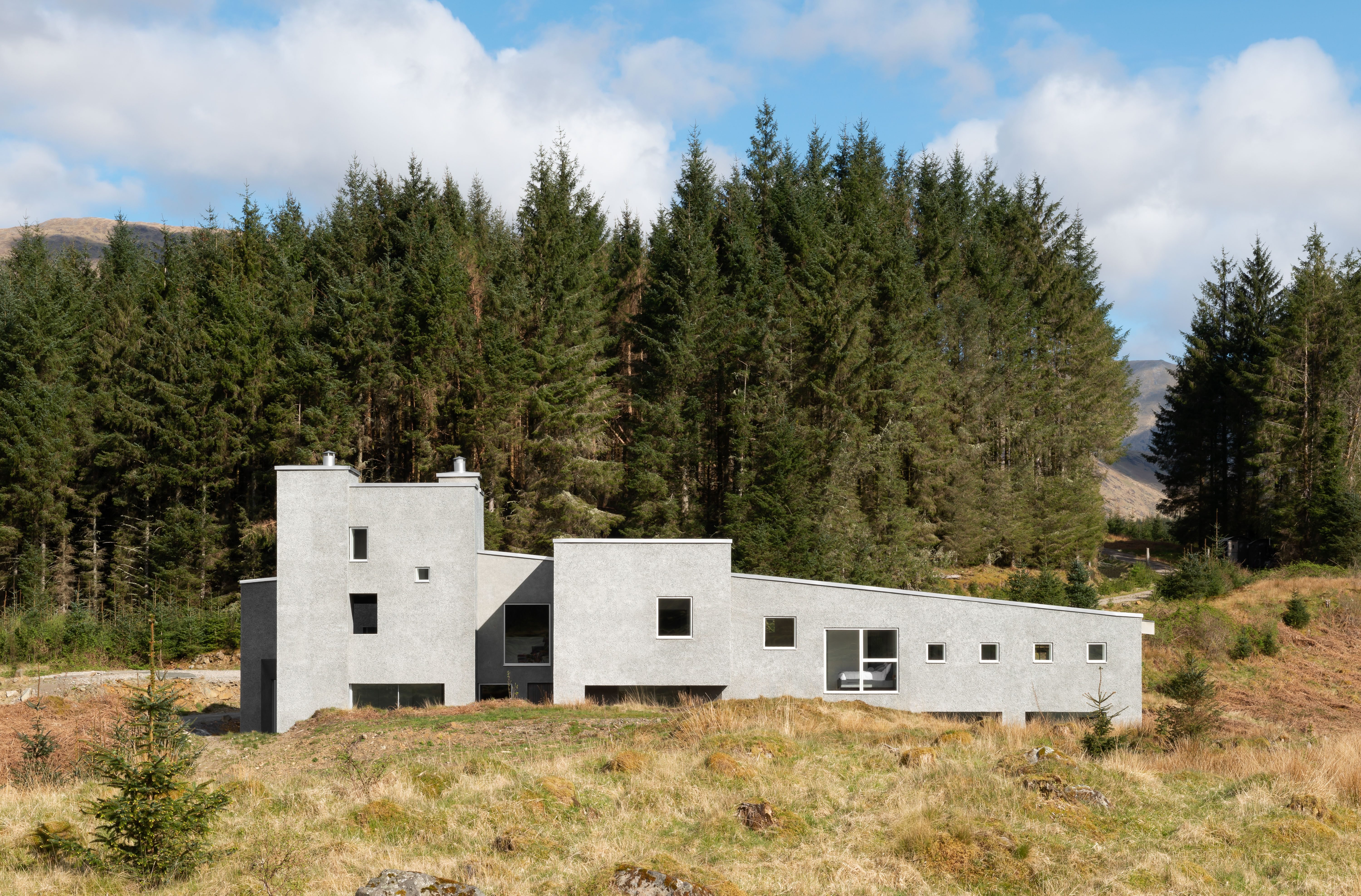
Our client at Hundred Acre Wood had a once-in-a-lifetime site looking out to Loch Awe and a determination that this project — a home for his extended family — must not be rushed. So the house is shaped by time, the elemental landscape and traditional Scottish architecture, built narrow towards the prevailing winds and broader to face the sun and views south. Terraces, cutaways and openings are sculpted out of the mass, which is coated in a sparkling pebbledash of recycled TV screens. Inside, the plan extends from a central hall, scaled to fit the family’s giant Christmas tree.


—
Our client at Hundred Acre Wood had a once-in-a-lifetime site looking out to Loch Awe and a determination that this project — a home for his extended family — must not be rushed.
So the house is shaped by time, the elemental landscape and traditional Scottish architecture, built narrow towards the prevailing winds and broader to face the sun and views south. Terraces, cutaways and openings are sculpted out of the mass, which is coated in a sparkling pebbledash of recycled TV screens. Inside, the plan extends from a central hall, scaled to fit the family’s giant Christmas tree.

Our client at Hundred Acre Wood had a once-in-a-lifetime site looking out to Loch Awe and a determination that this project — a home for his extended family — must not be rushed.
So the house is shaped by time, the elemental landscape and traditional Scottish architecture, built narrow towards the prevailing winds and broader to face the sun and views south. Terraces, cutaways and openings are sculpted out of the mass, which is coated in a sparkling pebbledash of recycled TV screens. Inside, the plan extends from a central hall, scaled to fit the family’s giant Christmas tree.

—
A modern ‘castle’ has appeared in Argyll — but while resembling a stronghold of old, this is a playful place designed for good times...
Homes and Interiors Scotland


It is a fabulously rich project in which spaces are dramatic and varied in proportion, and expertly handled in material detail.
Judges’ citation, 2023 RIAS Laurence McIntoch Architectural Interior Award


The space feels both deeply textured and lightly reflective. It’s magic.
Judges’ citation, 2023 RIAS Laurence McIntoch Architectural Interior Award


The Scottish baronial palace was a starting point for our client. We looked at how traditional Scottish architectural forms such as hollow-walled, Iron Age brochs related to their landscape.

The abstract sculptural work of Eduardo Chillida provided a reference for a house shaped by the elements.
View of loch from site (RIAS presentation)
Broch cross section
Tower house plans
Mackintosh interior
Chillida piece
Pebbledash reference
Sample board including TV aggregate
Inverary Castle maltings exterior
Making a grand statement was never the main point of this project, either for the architect or the client. ‘The house is autobiographical and was built around us and our needs as a family,’ explains the owner. ‘We’re in the fortunate position that we’ve done what’s right for us rather than what might appeal to somebody else.’
The story of how Hundred Acre Wood came to be began 15 years ago when the owner spotted the plot for sale. 'I was flicking through the Herald’s Wednesday property supplement and I saw an ad for a plot on Loch Awe,' he recalls. 'My wife and I had always thought it would be lovely to have a house overlooking the sea. Of course, Loch Awe is not the sea, but we put in an offer anyway and it was accepted. We didn’t have a burning desire to live in Argyll; it was very much the plot that sold itself to us rather than us going looking for it.'
The project finally got off the ground eight years ago when a combination of serendipitous family encounters and word of mouth led the couple to London practice Denizen Works and its Scottish architect Murray Kerr. The original brief was for a 1,100sqm Scots baronial palace with a wide front. As architect and clients got to know each other, however, ideas evolved and things changed.
'When we started our conversations with Murray, we were in a very different place,' acknowledges the owner. 'The initial ideas we had were based on what we knew. We’re not architects and haven’t studied architectural history. We didn’t have an absolutely fixed idea of what we wanted. One of the successes of this project is that we weren’t in a rush to do anything, so the plan had time to evolve. Murray can take credit for opening our eyes to different options and solutions.'
Caroline Ednie, Homes and Interiors Scotland

Making a grand statement was never the main point of this project, either for the architect or the client. 'The house is autobiographical and was built around us and our needs as a family,' explains the owner. 'We’re in the fortunate position that we’ve done what’s right for us rather than what might appeal to somebody else.'
The story of how Hundred Acre Wood came to be began 15 years ago when the owner spotted the plot for sale. 'I was flicking through the Herald’s Wednesday property supplement and I saw an ad for a plot on Loch Awe,' he recalls. 'My wife and I had always thought it would be lovely to have a house overlooking the sea. Of course, Loch Awe is not the sea, but we put in an offer anyway and it was accepted. We didn’t have a burning desire to live in Argyll; it was very much the plot that sold itself to us rather than us going looking for it.'
The project finally got off the ground eight years ago when a combination of serendipitous family encounters and word of mouth led the couple to London practice Denizen Works and its Scottish architect Murray Kerr. The original brief was for a 1,100sqm Scots baronial palace with a wide front. As architect and clients got to know each other, however, ideas evolved and things changed.
'When we started our conversations with Murray, we were in a very different place,' acknowledges the owner. 'The initial ideas we had were based on what we knew. We’re not architects and haven’t studied architectural history. We didn’t have an absolutely fixed idea of what we wanted. One of the successes of this project is that we weren’t in a rush to do anything, so the plan had time to evolve. Murray can take credit for opening our eyes to different options and solutions.'
Caroline Ednie, Homes and Interiors Scotland