
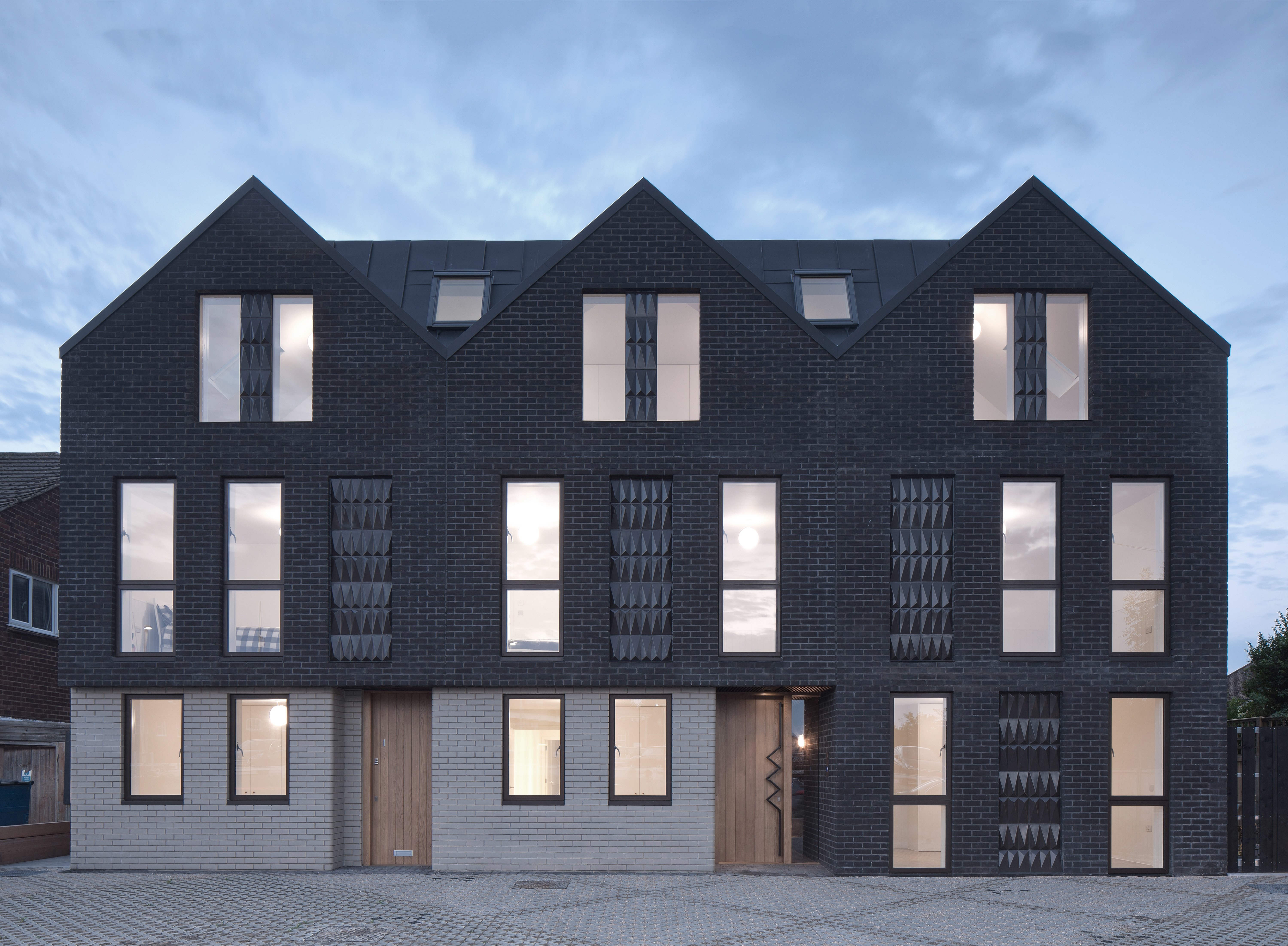
The seven apartments at Haddo Yard in the seaside town of Whitstable are the outcome of an open-book relationship with developer Arrant Land — and prove that confident, place-specific housing can be built in the local market for an ambitiously tight budget.
Utilitarian materials and pitched gables reference those of the sea wall and fishing sheds, elevated for a domestic setting. By reconfiguring the plans during detailed design, budget was released for fine-tunings with an Aleister Crowley connection, and bespoke, Whitstable-made details that lift the homes above a standard spec.


Sitting opposite the train station, Haddo Yard’s name, triangular gables and fine detailing reference The Magician by Somerset Maugham, who lived here in Whitstable. The character of the eponymous magician, Oliver Haddo, is based on the occultist Alestair Crowley.
The close working method between Kerr and Blackmore suggests a genuinely productive relationship between architect and developer.
Charles Holland, Architects' Journal


Form, materials and details found in Whitstable.


Blank panels set with decorative faience tiles are also functional, masking the party walls between apartments. A base of pale grey brick topped with coal-black cladding evokes the tar-painted fishermen's huts on the seafront.

Rendered in crochet for Knitstable.

Coastal planting and a concrete garden wall, inspired by the sea defences and shuttered with an old shed found on site.
In its intelligent planning and robust detailing it is way ahead of what one might expect.
Charles Holland, Architects' Journal


A dark timber ceiling gives better acoustics in the shared hall space.
The miserable beige bungalow opposite the station was a sorry sight for people arriving in or travelling through Whitstable. When it came up for sale, we recognised the opportunity the site offered for density, but also for engagement with ideas about the place’s identity. It was cheap, on a large plot and quickly bought. So began an exploration into what a new building in such a prominent position could say about a town — this town.
Every part of the process was investigated as an opportunity to improve, enrich or economise. We knew we wanted a building that spoke eloquently of Whitstable, but it was choosing a name for the project that brought it to life. Oliver Haddo’s libertine influence was in healthy tension with the well-mannered built context of the town and created a ‘safe space’ for some unusual ideas. Conversations about the materiality of the town’s sea defences touched on the occult. Door handles became ceremonial maces.
Duncan Blackmore, Arrant Land, from the Architect's Journal
“I stumbled across this when in Whitstable for an orienteering event, and can confirm it’s a really good attempt to match the traditional building style of fish lofts near the harbour.”
Ian Byrne, Dezeen comments


Haddow and Crowley references, as seen on Munro and at the pub.