
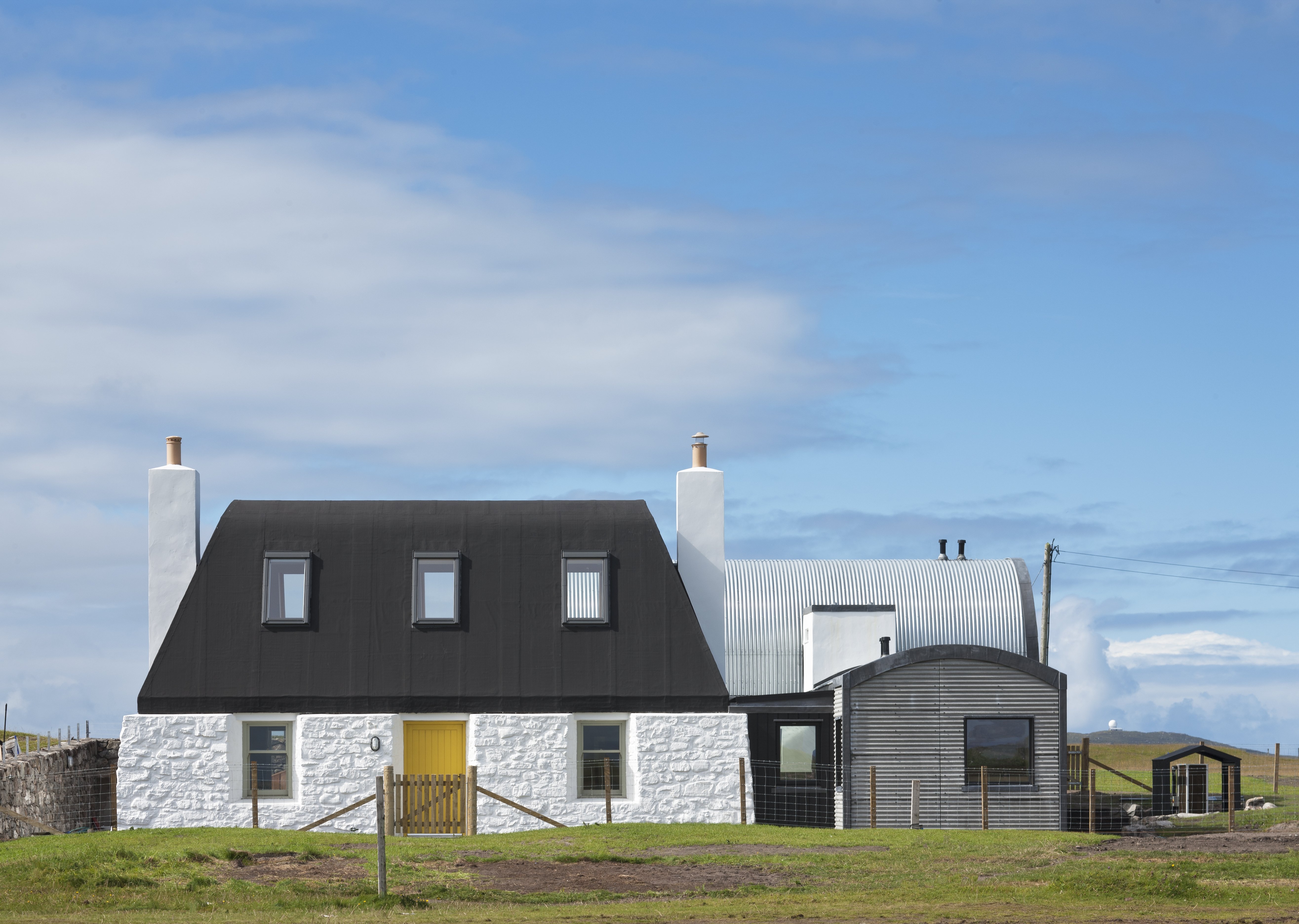

House No.7 sits on the beautiful Island of Tiree, the western-most of the inner Hebrides, with views out across the machair, the sea and the islands beyond. Conceived as a Living House, for the clients to use throughout the year, a Guest House; containing three bedrooms and associated accommodation; and the Utility; containing much needed welly storage and space for the necessary effects required for island life.


The architecture is characterised by a mix of both a traditional black house and agricultural steadings all integrated into the landscape.
What do you get if you mix urban design with the local vernacular and a ruined cofter's cottage on the isle of Tiree? Denizen Works' House No 7, finds Rory Olcayto.
The Architects' Journal


A couple of years ago Denizen Works made the AJ Small Projects Awards shortlist with its mobile sauna; a timber hut-cum-sledge with a glass door and cute chimney. It was designed by studio founder Murray Kerr for a client in Finland who had failed — after 12 years of trying — to convince local planners that her disused boat shed would be more useful as a steam room. Kerr soon discovered the planners were fine with mobile structures, so he proposed a large-scale sledge that could be hauled onto the frozen waters that surround his client's house during the winter months. The planners said 'fine', so Kerr and a few pals set about building it with local timber, completing it in nine days. What's more it proved light enough for a horse to tow around. Job done.
AJ Small Projects is a good testing ground for an architect's potential: budgets are tight and, more often than not, constraints are pretty tough. The best small projects, then, are usually done by architects with great promise. That has proven to be the case with Denizen Works. In January this year, it was one of 20 firms shortlisted for housing association Peabody's ( coincidentally named) Small Projects Panel and, though it failed to be named as one of the six winning firms, it came away with a high commendation. Which brings us to this: Denizen Works' House No 7 on Tiree, a cluster of stubby, functional-looking blobs huddled together on the tiny island's southern coast, and another strange, clever building by this curious, offkilter studio.
Tiree is clearly part of the British Isles, but the flat, windswept island is a world away from London. Surprised? Didn't think so. But it's a world away from Glasgow, too, where I boarded my plane to Tiree. And if that is still a rather obvious point to make, let's go a step further and say Tiree is also a world away from Oban, the main ferry port that serves this outermost of the Inner Hebrides. There's nothing anywhere else in the UK quite like Tiree. Compared even to its sister Atlantic outcrops off the west coast of Scotland, Tiree is still a world away. Billy Connolly used to tell a gag about the sentimental bullshit Scottish folk singers get away with, citing a song called The Misty Blue Hills of Tiree, and taking issue with this view he thunders: 'If you've ever actually been on Tiree, you'll know it's like a bloody billiard table.'
Which also helps make it one of the windiest place in Britain - there are no trees to smother gales into something resembling a breeze and looking westwards, the next lump in the water you'll come across is Canada.
Locals — and John Craven's Countryfile (to the ire of message board obsessives arguing in favour of their own towns, usually on the south coast of England) — will also tell you it's also the sunniest place in Britain. I was there in mid January. And guess what: it was sunny. It was raining too, and there were frequent lovely rainbows set against formidable grey-black skies one minute and what looked like computergenerated cyan-blue skies the next. But there was something strange about the rain: it didn't touch the ground. Instead, the wind blew it across the island into a hovering band of watery mist that was actually quite pleasant to walk through when Kerr took me on a tour of the local sites.
SUMMARY TEXT
Made for multigenerational living on the beautiful Hebridean island of Tiree, House No 7 is a cluster of familiar forms that aren’t really architecture at all, an agricultural family grown from the machair. The three parts – a traditional wide-walled cottage for sleeping, a corrugated steel-clad barn for living and a functional utility shed containing much-needed welly storage – huddle around a sheltered central hall, their strong exteriors facing the wind to protect a softer interior.
[74 words]
IMAGE CAPTIONS
Sea View
Windows are cut to frame views across the machair to the sea and the islands beyond.
Cottage Elevation
The cottage is the primary element, repaired from a traditional black house.
Garden
Although the secondary elements – for living and utility – have the character of agricultural steadings, their composition with the cottage creates an almost urban condition of shelter and privacy in the sunken garden.
Light chimney
The elements give the feel of having been accrued over time, with changes of level, light openings and interlocking spaces.
Kitchen table
A warm living space, sheltered from the elements.
Long Close View
The cluster hunkers down in the exposed landscape.
Hall (or wider shot taken from existing website)
Whitewash on the outside is protection from wind, salt and sand; the stone is exposed on the inside.
Internal-Moors
The utility has space for Lego-building and play, and storage for the essential effects of island life.
Wide internal
Materials are simple: a barrel vault lined with skirting boards, set in bays.
Longest View
The house provides shelter in the wild island landscape of shore and machair.
Night cladding/Living house grass
Agricultural coating: the same corrugated sheeting as a crofter’s shed.
Chimney shot
Tall chimneys to match the neighbours.
PULLOUT QUOTES:
“This tight development utilises both the traditional black house form and more agriculturally derived structures to create main and guest houses within its enclosed setting, all elegantly drawn into a unified internal composition.” Judges’ citation, RIAS Awards 2014
“This house is notable for the tactile pleasure which is invoked by every simple activity, even just opening a door.” Judges’ citation, RIBA Manser Medal 2014
“Is it my imagination or does this look like a couple of caravans?” Functionalbeauty, Dezeen comments
“A cluster of stubby, functional-looking blobs huddled together on the tiny island’s southern coast” Rory, AJ
“While I salute your efforts, I would be happily surprised if these chimneys survive the next storm force 13 that comes along.” Ageibaz, Dezeen comments
EPHEMERA:
Cake from Aberdeen cake-off
Reference images of agricultural buildings, Nissan huts, Tiree vernacular
Composition sketch from Murray’s All views my own presentation
Mixed materials picture from All views my own
Annual photo of kids in the window
MK’s mum and dad at home
Oban Times clipping
New York Times clipping
?Maps of site/ferry tickets
?Site photos before/during construction
?Photo of Murray presenting to the family
LONGER AS FOUND TEXTS:
Rory in the AJ:
“There’s nothing anywhere else in the UK quite like Tiree. Compared even to its sister Atlantic outcrops off the west coast of Scotland, Tiree is still a world away… Which helps make it one of the windiest places in Britain – there are no trees to smother gales into something resembling a breeze and looking westwards, the next lump in the water you’ll come across is Canada.
I was there in mid January. And guess what: it was sunny. It was raining too, and there were frequent lovely rainbows set against formidable grey-black skies one minute and what looked like computer-generated cyan-blue skies the next. But there was something strange about the rain: it didn’t touch the ground. Instead, the wind blew it across the island into a hovering band of watery mist that was actually quite pleasant to walk through.
There are other, quite specific elements that make Tiree special. Machair, the rare habitat local to the Hebrides, is one and its almost luminescent yellow, white and purple flowers are pretty in the extreme. Machair is a type of coastal dune pasture with a high shell content that provides a fertile agricultural base. And it’s everywhere you look.
…
From the outside, the building resembles a mash-up of all the kinds of crofts described in the Pevsner guide. If you think that there is something awkward about how the masses cohere, from the outside, you would be right. It is like that in the flesh too. It is not a drawback, mainly because this is a building that really works as a kind of private townscape, Each distinct element of it overlooks, or looks up to, another part, an approach that perhaps stems from Kerr’s time at BDP where the former chairman, Tony McGuirk, specialised in this kind of ‘atomised cluster that is really one building’ approach.
The building’s real success is the home it creates within its ever-so-slightly overworked shell. Once you enter through the front door, you alight onto the concrete floor of the ‘hall’. It’s more like a kind of street corner or crossroads; with steps down to the master bedroom, steps up to the barrel-vaulted kitchen (the heart of this family home) and views up to the chimney through a generous glazed roof and also into the studio-style painting room (with a table that turns into a bed – it’s a big family).
There is plenty of room. You will not bang your bones on table edges or corners into rooms. It’s warm. Friendly. And, dare I say it: cosy. The plan has been carefully thought through. I know it works because of one simple test: I stayed overnight, and managed to find my way down from the first floor guest house, across the hall, up the steps to the kitchen and pour myself a glass of water without switching the lights on. It was pitch black. How about that? It was simply a matter of familiarity, despite the spatial complexity that comes together to make this the place it is.”